
You're a Cowboy Like Me
Poet Lorena De Luna explores community, culture, and compassion in the first formal reading of "Born on the Border"

I’ve got some tricks up my sleeve
Takes one to know one
You’re a cowboy like me
-Taylor Swift
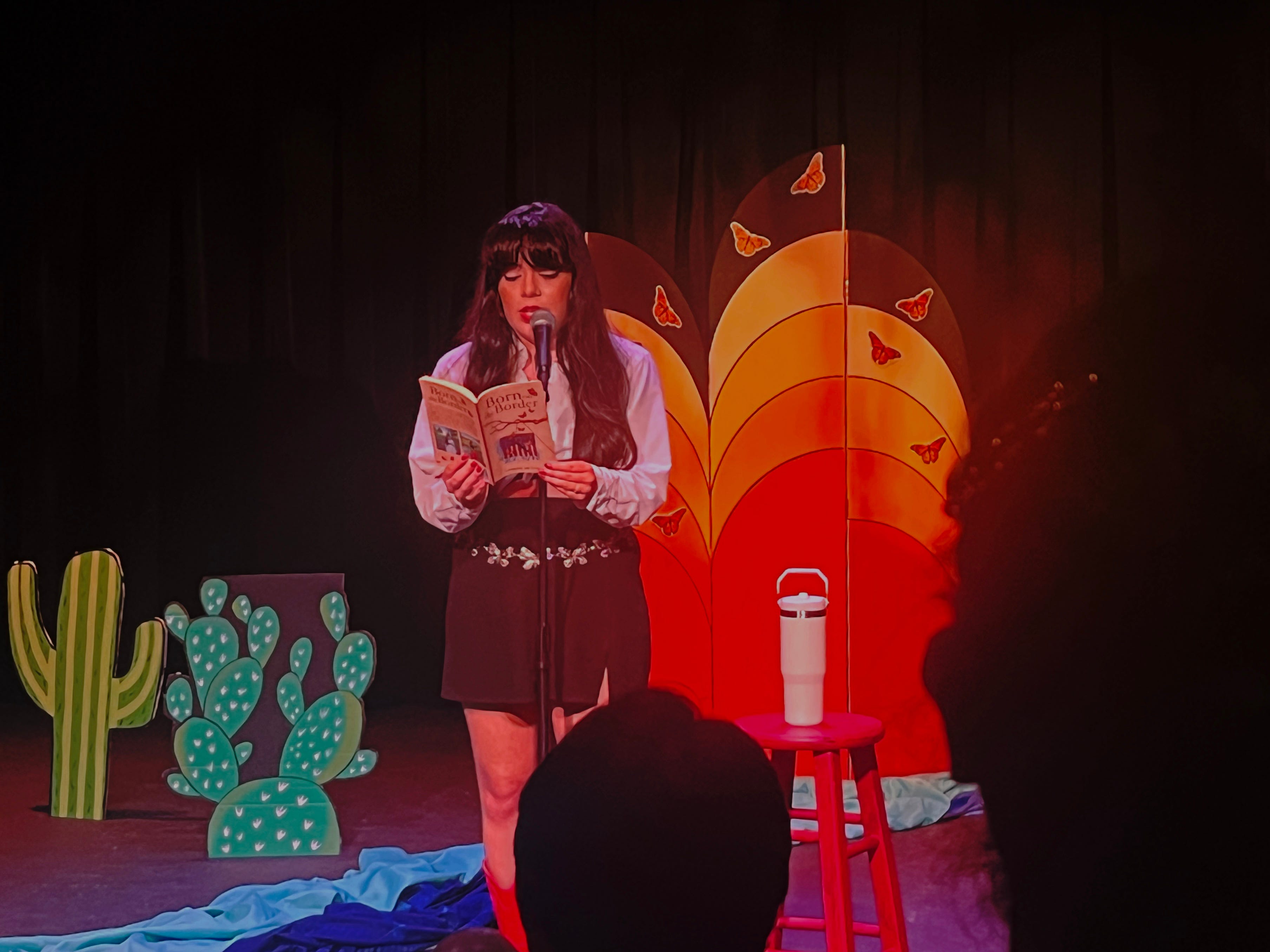
Taylor Swift floated softly through the Bath House Cultural Center’s auditorium as the audience settled in. Some thumbed through signed copies of “Born on the Border,” comparing poems with the flyer on their seat listing themes and titles. Others started planning how they’d put together their complimentary collage kits. At the front of the room, a blue cloth Rio Grande wove through hand-painted cacti. There was soft chatter, but nothing louder than you’d expect from a poetry reading.
A hush settled over the crowd when Lorena De Luna took the stage.
“Born on the Border” is Lorena’s first publication. The book is a collection of 43 poems in both English and Spanish. They reflect on life in Brownsville, Texas, and its sister city Matamoros, Tamaulipas. The poems broach topics like culture, work, family, immigration and socioeconomic status. They weave together Lorena’s personal journey – growing up, going to college, finding work – with that of her community.
“I wrote this book and dedicated it to the people from the Rio Grande Valley, from South Texas, but, you know, my goal with it is also for people to see that we have more in common than what separates us,” Lorena said.
Lorena decided to self-publish “Born on the Border” because traditional publication is a years-long process.
“Given what’s been happening in this country, and what I knew was going to happen to Hispanic people, I was like, this needs to get out there in the world,” Lorena said.
“I want people to see our best parts … because those stories weren’t really told, and if you see Hispanics in media, it's always the same stereotypes. Like we’re just criminals … It’s always just things that aren’t painting us in the best light, and I wanted to give my community something that painted them the way that they deserved to be talked about.”
Though she’s read her poetry at open mics and the book’s launch party, this was Lorena’s first formal reading. Throughout the night, Lorena read 12 poems requested by the audience, such as “Panaderías in the Winter.” It’s one of Lorena’s favorites – “I say as if I didn’t write the book.” A nostalgic smile pulled at her lips as she brought the audience out of the August night into chillier days.
“Whenever there’s a cold front, it’s the time to get pan dulce,” Lorena said. “Pan dulce, like sweet bread, like baked goods, like pastries. There’s muffins and cookies and things, and there’s also, like, empanadas, conchas- those’re the traditional Mexican ones … and then you get coffee.”
But the poem’s warmth doesn’t just come from stirring your sweet tooth. Even with all the options, Lorena’s father knows exactly what to get her, “because he knows her go-to order.”
“My dad would literally come home [from the panadería] randomly, and my mom would get mad,” Lorena laughed. “She was like, ‘You got another one?’ Like, ‘We just had one, like a few days ago!’ When it's cold, you just want a sweet treat.”
Lorena described the people of the Rio Grande Valley as a hardworking, family-oriented community.
“It really was important for me in this book, and then when I talk about it, to talk about … family sacrifices and the grit of generations breaking out of poverty; to talk about how hard they work and sacrifice, … and love each other,” Lorena said.
“Fruits of Labor,” another poem read at the event, juxtaposes Lorena’s experience stuck at a difficult job with her mother’s childhood work as a migrant farmer.
“She had a lot of siblings, and she was the oldest … she would spend her summers harvesting fruit and vegetables and, you know, her family needed the money,” Lorena said. “I write about that in it, and it’s during this time in my life where I’m a young adult, and I'm trying to provide for myself.”
Lorena credits her strength to her mother. At one point in the night, she asked for a show of hands for who could relate to their parents working hard to give them a better life. The room was filled with people of all ages, races, and backgrounds, and nearly every hand was raised.
“I'm contextualizing my suffering basically of like, you know, this is hard, but … there are people who are living a harder life than you, and … if you can help those people and lift them up, you should,” Lorena said.
Those feelings echoed in “Piñata,” a poem about the first time Lorena saw her culture politicized. She was eight-years-old when she saw a piñata of a brick wall strung up and smashed near the border fence. Lorena was confused at the time, but the image stuck with her. Now, it’s on the cover of her book. Tears came to her eyes as she finished reading the poem.
“That line on the second page, ‘the pain I feel, is it a symptom of prosperity?’ I just feel it very deeply, you know?” Lorena asked, voice still shaking. “Working in the industries I worked in and just being better off than my parents were- and that was planned on their part, obviously … Family, parents in a lot of situations want you to have more than they had.”
Lorena’s parents, first generation college students themselves, worked hard to give her education and resources they didn’t have access to.
“I started volunteering for different causes, mostly focused on like, food insecurity, since I was eight,” Lorena said, “Because, you know, my parents … came from really poor families, and so they had to do a lot to overcome that.”
Lorena recently partnered with the North Texas Food Bank to spread the word about Sin Hambre, “an official NTFB cultural Affinity Group led by the North Texas based Hispanic and Latino community,” according to their website. The name translates to “without hunger.”
Lorena’s minor in social work has given her a deep understanding of the struggles people face in impoverished communities.
“I’ve worked in food insecure spaces for a long time,” Lorena said. “There’s this misconception that people are just lazier; people don't care to take care of themselves, or don't care to take care of other people; when there's a lot of circumstances where people end up in those sorts of situations, and giving them empathy and … understanding, and being there for them is really important.”
Some of these situations come to light in “Braceros & Vaqueros.” The poem mentions two times in US history where the country invited Mexican laborers in: the Bracero Program, originally created to fill agricultural shortages in World War II; and vaqueros, Mexican cattle herders who laid the groundwork of cowboy culture.
“There are multiple times throughout history where Mexican people specifically, but you could say this about a lot of groups, where the United States … brings labor in, brings talent in, brings culture in, and then kind of throws people back,” Lorena said.
Both subjects are fascinating to Lorena, who was a US history tutor in college. Her father is also a retired history teacher.
“They started the Bracero Program, where Mexican people were allowed to come to the country and work in the fields for pay – which, in some ways, they didn’t get paid, or they didn’t get proper housing or food,” Lorena said.
Her understanding of both the past and the present has led Lorena to a life of advocacy.
“I let go of the idea that the word ‘politics’ is taboo,” Lorena wrote in her author’s note. “I recognized that the work I wanted to do in social impact spaces was intertwined with politics. The need for charity work is often because of the failing systems that exist in the country, and I was determined to be a part of the solution to ensure people have equal opportunities.”
“I’ll Speak Your Name” is one of three Spanish poems in the book, though each has an English translation. Like the other two, it reads as a reassuring love letter to her community.
Lorena wrote “I’ll Speak Your Name” after working for Kamala Harris’s presidential campaign in Washington, D.C. During her time there, Lorena worked on many projects, including creating voter education resources in Spanish.
“I was really lucky to be in a position like that, working in D.C., and I wanted to keep … my community and my culture top of mind when coming back, and making sure that I was still helping, you know, move my community forward,” Lorena said.
“Spread the culture, the language, everything just to keep them in the headlines, but for good news, for good things, and to speak highly of the people that I grew up with.”
Lorena’s biggest fear in writing “Born on the Border” was that she wouldn’t represent her community and their experiences well. She’s since been assured that isn’t the case, but she hopes her poetry inspires others to tell their own stories and chase their own dreams.
Staphany and Crisel are in a book club that focuses on Latina authors. Many in the audience heard about the poetry reading through TikTok, but Staphany saw a flyer for it at the Bath House Cultural Center while she was looking at their displays.
“I’m like wow, that’s really relevant to what we like to read!” Staphany said.
She invited Crisel, who’s also a poet.
“[Lorena’s] story and my story are very different, but I can still relate, for example, on the ‘Panaderías in the Winter,’” Crisel said. “That is something that I’ve introduced my husband to. Every time that there’s a cold front, or even when it rains, we go to the bakeries in our neighborhood.”
During the event, Staphany asked Lorena to read “Mexican Dental Hall.”
“My mom, she recently went to get dental work in Mexico. It wasn’t the reason that she went, but it is affordable, whereas over here, you know, the healthcare system and everything- she just retired,” Staphany said. “So I can kind of relate to that disparity.”
“I could relate to some of the poems, but I think what really got me hooked was [Lorena’s] heart for the community,” Crisel said. “That’s what makes me want to- well, first, support her by buying her book, and second, read it together for our book club.”
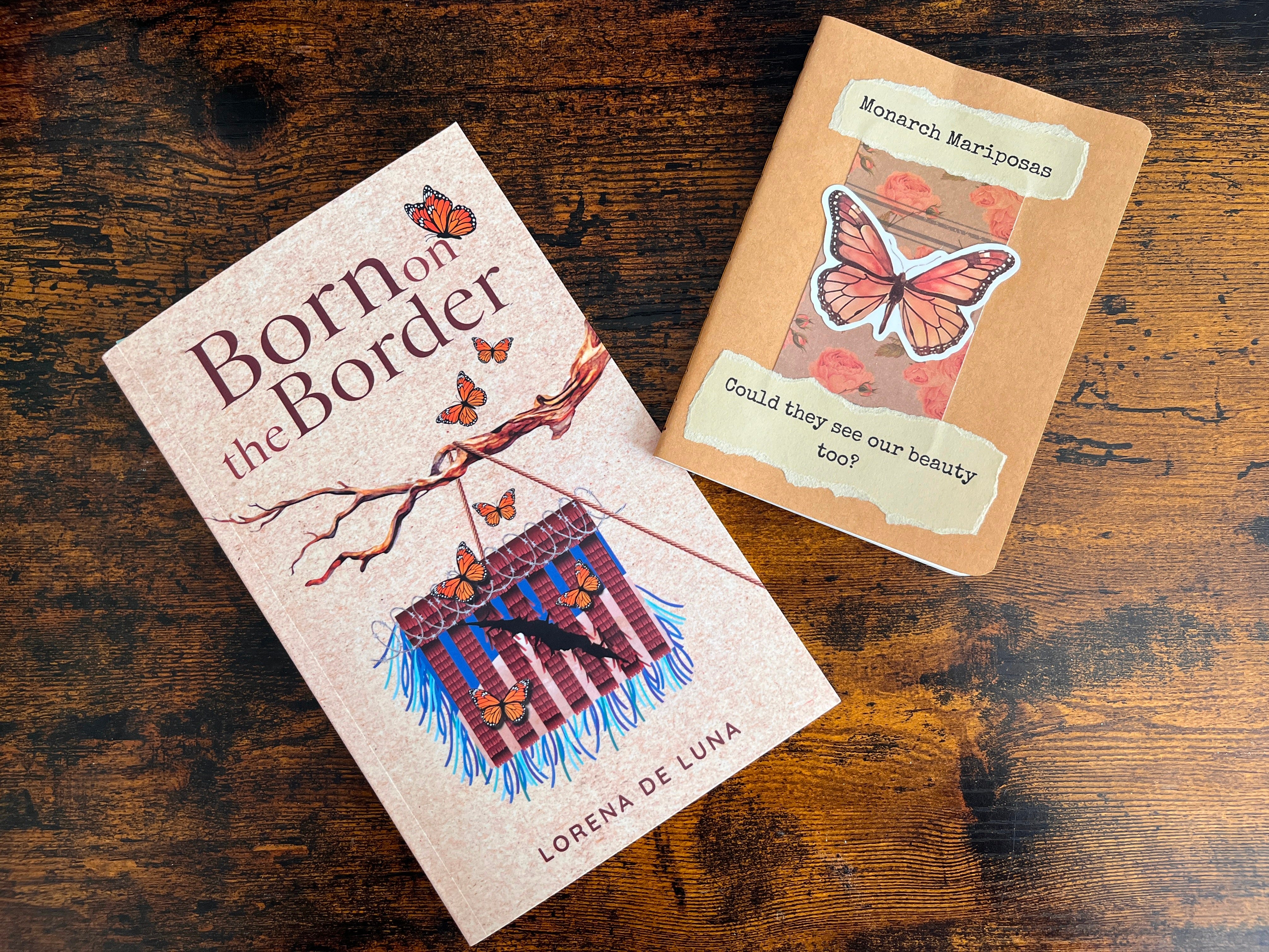
Lorena’s heart for her community comes to a head in “Monarch Mariposas,” the final poem of the collection. Monarchs are a major symbol in the book, and can be found on the cover as well as the painted backdrop on the stage. They’re an important symbol in Mexico and Texas alike.
Lorena wrote the poem after seeing a video of thousands of migrating Monarchs.
“I saw the comments, and people were like, ‘Wow. This is amazing. This is beautiful.’ And in reading that, I was like, I want people to feel that way about immigrants.”
If you’d like to read “Born on the Border,” you can find it at Barnes & Noble. You can follow Lorena on TikTok and Instagram to see what she’ll do next.